Sunday, 29 November 2015

Double-Page Spread Deconstruction: NO 3


The genre of the magazine is easily definable just from a brief observation. 'Last choirs standing' supports an orchestral or choral theme, relating it to classical music. 
Colour choice also emphasises the traditional aspect of classical music. The tinted beige and faded bronze have prestigious connotations, giving the magazine an implied audience of upper class readers. 
With the image, the mis en scene of the church and youthful choir demonstrates how multiple generations have taken up the mantle of traditional vocal singing, creating the reassurance of classical music's future. To support this, the smaller image embedded in the text depicts an older mentor, expressing how the skills are passed on. Additionally, this establishes that the tone will be formal due to the original background of classical music and the associations it has with the upper classes. 
'Last choirs standing' as a heading creates urgency due to its play on the common 'last man standing' idiom, which suggests that things are in dire supply. The stand-first begins by evoking negativity, using phrases like 'dwindling nationwide' to promote the scale of the problem, but is then balanced with phrases such as 'initiatives to re-engage Britain's youth' which restores the possibility of hope. This introduction acts in the format of a narrative discourse, using a summary paragraph to establish the journey from an initial problem to  a resolution, suggesting that the article will adhere to a narrative structure.
Titling the article 'The Future of Choral Music' in the top right corner helps to generalise the topic, as well as bring classical music into the modern day. Saying that there is a 'future' for classical music emphasises that it still has a place in the music industry. Therefore the audience are reassured from an economical perspective that the classical genre is not in fear of being put out of business. 
I would like to draw attention to the font, which allocates an archaic style to provide it with the necessary authenticity of traditional documents. 
Finally, the layout of the page is structured and organised with a clear reading path, since there are no extra boxes of text. The short columns make the article appear less daunting because it is spaced out across the double page, whereas if it had been condensed onto one page like the Q magazine, it would appear overcrowded and too much to read. 


Friday, 27 November 2015

Double-Page Spread Deconstruction: NO 2


I picked this double-page spread to highlight the difference in layout from my previous deconstruction. This is from another successful magazine, Kerrang. 
The first major difference is how both pages are intertwined. The Q magazine allocated the left page to the photograph and the right to the text, and although that proportionality is applied here, it is less distinguished. For example the headline bleeds across both pages and the background of the main image is used as the background for the text to show continuity. This layout also enhances the scale. Although it is not physically bigger, the way in which the sections are spread out helps to give the page organisation and is less intimidating to the reader. 

Wednesday, 25 November 2015

Double-Page Spread Deconstruction: NO 1


As I established at the start, double-page spreads often take a very creative and unique format, meaning that very few adhere to the same conventions. 
For my first deconstruction of a double-paged spread, I wanted to choose a popular and recognised magazine company in. This extract is from Q, and the logo has been been highlighted in small print next to the page number at the bottom. Branding and promotion is a very common feature of a music magazine, and the logo will be present on most of the pages to familiarise the reader with it so that they build up associations. In this particular example, it is not only the logo that enforces the idea of 'Q', but also the colour. The red and white shades feature heavily across the page, which further causes the reader to associate these colours with the 'Q' magazine. Outlining the first letter of the artist's name in large print across the page is a convention in this magazine, showing uniqueness and how these articles deserve their own way of being identified. 
As a way of comparing this feature, the issue above about Lady Gaga follows the same layout. 
Although very artistic, the layout is simultaneously quite basic: the left side is a full page photograph of the artist whilst the right has a full page of text. This simplicity pays off; the photograph is the first thing the audience see and so if the artist interests them, they can take the time to reader about them. 
From the amount of text on the page we can infer that the articles are intended for long-term fans who will be passionate enough to read for that long.  For those less engaged with the celebrity, the quotation that captions the picture can be used as a way of enticing the audience into at least attempting to read the article. In this example, Jay Z is making a statement about his long-term public feud with artist Noel Gallagher. Therefore even if a reader is unaware or uninterested in Jay Z, they might be provoked by the hinted conflict he has with the Oasis singer. 
The image is overshadowed with a crimson shade on one half and a white shade on the other. Red and white have juxtaposing connotations of colour, where red is the colour of the devil and white is associated with angelic purity. The merging of this suggests that no one is completely good or bad, and that Q exposes the reality of both in their magazine. 
The close up demonstrates Jay Z's imposing expression. Concealing his eyes with glasses is not only a stereotype of the rapper, but also distorts the idea of direct address. Since the audience cannot see his eyes, there is anticipation knowing he might be glaring or looking in another direction. This draws you in because the photo is usually a representative of the tone of the article. Since the quote already hints towards conflict, the image could support the idea of tension and anger within the article. Wearing a black top correlates with his closely-shaved haircut and his black glasses, showing synchronisation in fashion in order to not distract from the article. 

Monday, 23 November 2015

Contents Page Deconstruction NO 3


Mojo was originally established as a classic rock magazine, but has since expanded to diverge towards other genres and artists. The notable difference between this and the other contents pages I have analysed is that Mojo uses a very minimalistic approach. In order to gain an understanding of why this style is adopted I think that there needs to be an awareness of the front cover:


The crammed information and vibrancy of the front cover contrasts the simplicity of the contents page, allowing for a smooth transition into the inside of the magazine. This is a convention present in all of their issues. 
Attached to the front cover is a free CD, and there is a retro colour scheme that offers a similarity to the style of the contents. This eases the reader into the changing format as they turn the page. As well as this it helps to promote the historical context of the group due to their significance in the past. It helps the reader to comprehend what sort of era the band were in their prime. 
The contents page uses only three colours; black, red and white. The white (like in all contents pages) serves as a backdrop that doesn't distract from the intentions of the text. In this case it also enhances the style of the artist, photographed in black and white. Using black for the font supports this retro theme and gives the entire page continuity through how both the image and text are interconnected by the choice of colour. 
The member of The Who represented in the photograph is sat in a casual position with his guitar, illustrating both his profession and devotion to music. His expression is very concealing, he is neither happy nor sad which emphasises how he takes his music seriously. By using direct address he comes across as sincere and genuine. The lighting in the photograph leaves half of his face in shadow, suggesting that there is more to be learnt inside. Worthy of note is how there is only one photograph and the fact that it is an extension of the image on the front cover shows The Who's celebrity status and importance to this issue. 
Structurally, the way that the text forms neatly around the outline of the image creates an aesthetic creativity, showing that the individual sections have converged to establish cohesion. 
Another trait is that the headings do not have wit or puns and simply states the name of the artist being addressed. This allows the reader to quickly isolate the parts that interest them so that they do not feel withheld by having to read through lots of grammatical advertising. 


Saturday, 21 November 2015

Contents Page Deconstruction: NO 2


This contents page is from the rock magazine Kerrang (identifiable from the title which is onomatopoeic for the sound an electric guitar makes). 
A notable connection to the rock genre is the use of colour to act as headings. The yellow writing on a blacked out border serves as a stereotype of colours associated with rock. The tinted scratches of the font also correlate with the style of the title, showing continuity and the idea of a derelict society, a theme often present in rock music. 
Once more the background for the contents page is simplistic and plain, so the choice of white allows for the headings and page numbers to be distinct and imposing. Furthermore, using 'This Week' as a sub-heading shows how the magazine is consistently up-to-date and on top of news. 
The image takes center stage and like the page I analysed before, it places the images at the top so that the readers will turn over to a visual theme. There is a look of intensity in the artist which is supplemented with the mis en scene such as the playing cards, which demonstrate a sense of uncertainty and manipulation. The direct address is enticing due to the manner of his eye-contact, since his eyes are so piercingly blue the audience feels almost daunted by this glare. A common appearance of rock artists is black outfits and long, black hair and this gothic style has been mimicked here, giving Marilyn Manson a mythical look.
As well as the main image, the additional photos offer extra visual insight into the content of the articles. The size shows the importance of their input, with Marilyn Manson being both the largest celebrity and therefore having the most focus within. 
The selection of words and phrases for the headings is a crucial element. For example using 'Feedback' in place of 'Reviews' offers a more constructive analysis whereas review has connotations of judgement and criticism. Another phrase like the 'Gig Guide' is alliterative and makes it easy to read in a catchy format. 
Including an extract from one of the editors along with a photograph allows the reader to have behind the scenes access, which humanises the magazine and gives the tone informality. It shows that the magazine isn't just operating as a product, but as a culmination of work that credits the input of the editors, writers etc. 


Friday, 20 November 2015

Contents Page Deconstruction: NO 1


This is the contents page for the Billboard music magazine. It can be identified that each section is distinguishable through the bordered dividers and squared outline. For example the 'features', which are the central articles of that issue, are listed in the center of the page to demonstrate their importance. What's more, placing three small images under the heading 'Contents' gives the reader visual appeal. The first thing that they see will be a picture which presents them with instant information, whereas if it was replaced with more text it would put effort on them to keep reading. 
Additionally it should be noted that each of the pictures denote various implications regarding the tone and public image of the celebrity it is representing. For example, number 20 has a simplistic image with the artist and his guitar, suggesting that he is unaffected by wealth and fame and just enjoys making music. Furthermore, the stereotype of a long beard and guitar could also imply that he is of the country genre. On the other hand number 42 evokes the idea of intensity and madness through the outfit. Plus the background compliments the fact that the artist possesses a very dark and gothic appearance. Their pose and outfit show that their genre is most likely rock, allowing the audience to make connotations about the sort of lifestyle they lead and whether or not they want to read onwards.  
The central image appears to be relatively casual in posture, but not in dress. The smart suit demonstrates that this artist style and wants to appear significant for his readers. He is looking with direct address, inviting the reader to engage with his simplistic body language, suggesting that he is comfortable and confident without being arrogant. 
Another noticeable quality is the lack of overwhelming colour; different shades of blue are used throughout to show variation but the text is black and the background is either grey or white, creating a simplistic structure for the audience to interpret. The central image is in black and white and so does not impose upon the text, whilst the features of the contents are segregated to the right, and split from the chart records. 
Including the 'NO.1' is enticing because the reader will associate it with popularity and acclaim. The decision to promote this on the contents page is a brief but well organised way of condensing down information. It could also be a tool for the audience to refer back to during the reading of the magazine because it establishes that the magazine is a reliable source with connection to the music industry.  


Wednesday, 18 November 2015

Front Cover Deconstruction: NO 3


Firstly, the obscured masthead suggests that the magazine is less intent upon drawing in new readers rather than sustaining a consistent audience. I think this because if an institution's primary goal was to promote the magazine, the masthead would be very imposing and visible, whereas the fact that it is not highlights that it's relying on the audience to already know. 
The image is framed between a mid-shot and a close up in order to reinforce the statement in the main cover line 'This is Chris Stapleton.' From it we can infer that the picture is depicting the artist in his true image. Another connection with the cover line is that 'dark horse' is a pun on the lifestyle and culture of cowboys as well as being a hidden talent. Additionally the hat, beard and leather waistcoat all share the stereotyped association of the West and of the country genre. Having the artist gaze out into the distance gives the cover an almost philosophical approach, as if the contents will tackle many emotive themes. 
An alternative interpretation would be that 'Chris Stapleton' is unaffected by his media attention, and portraying him in a location and manner complicit with his heritage shows that at heart he simply seeks to bring his fans music he loves making. 
Beige and lilac colours offer comparison to simplicity and relaxation, and the blurred lilac backdrop suggests that the sun is about to set. The lack of an invasive font and size of the cover lines shows that it doesn't want to appear to be desperate by trying to attract an audience. 
Quite subtly, the CMA awards advertisement shows that the magazine has connections with famous institutions, and thus has greater credibility with the support of a recognised event. It helps to boost  faith in the magazine knowing that it keeps up to date with the industry as well as the rural music.   


Tuesday, 17 November 2015

Front Cover Deconstruction: NO 2


'Vibe' itself has connotations of electronical and transmissive beats, which illustrates the magazine's focus on modern music. 
The mid-shot of the image engages with the reader's eyesight because they don't need to look too closely. Eminem's posture and body language evoke the idea of rebelliousness and defiance, a common stereotype associated with the rap genre. The exposure of his tattoos and choice of jewellery allows the audience to make assumptions about his life choices and personal beliefs. Vests are generally worn by labourers and tend to be associated with thugs, so this is complicit with the idea that the artist is in fact a rebel. Around his neck is a religious symbol, which begs the question whether it is simply part of his 'bling' or whether he is in fact a dedicated believer. 
In support of this, the main cover line 'Eminem comes clean' in answer to 'Vicodin. Valium. Methadone' establishes that he is defiant and the implication that he is revealing the truth inside engages the audience's interest.  Not only is 'come clean' a pun on drug-taking, but it carries the possibility that Eminem is starting to think differently about how he lives his life, thus offering insight to his fan base on his sense of morality and relating to the idea of confession expressed in the cross necklace.
Colour in this cover is quite provocative. Red, Black and Grey could evoke the danger and struggle that has come from society. Rap originated in the underworld and streets, often focusing its lyrics on themes such as anti-politics and wealth. Therefore the lack of positive connotations with the shades is a deliberate attempt to tribute the harsh lifestyle many rappers have endured. The colours and image emit intensity which could connote the type of audience the magazine is targeting. 

Sunday, 15 November 2015

Front Cover Deconstruction: NO 1


The cover above is the same example I used in my post about music genre.  I have chosen to analyse it because this cover is influenced by its genre and also follows a trait quite uncommon in magazine covers: centralisation. 
As depicted, everything from the masthead to the image to the main cover line are aligned in central positions on the page. The way in which the other cover lines are located evenly either side reinforces this sense of balance, and doesn't draw away from the central focus. This particular layout is done in the format of a poster, and has connotations that the magazine is more interested in the prestige of having these artists feature in their product above anything else. 
Following on, the retro colours of black and tinted gold evoke the implications of the rock genre. It gives the cover a classy appearance due the sleek and unintrusive shade, as well as adhering to the idea of 'classic' rock. This lack of lots of different colour allows the white masthead to stand out and the 'free CD' advertisement to be noticed. 
The image itself is unambitious and relies on the established fame of Metallica to draw in the audience, rather than simply fancy camerawork. Including a guitar makes the artist seem both knowledgeable and faithful to the rock genre, and his stance implies control despite the aggressive themes of rock music. 
The cover line 'from tragedy to supernova' demonstrates that there is personal significance behind the  journey towards their success, thus enticing the reader to engage with their backstory. 
Placing 'Metallica' in front of the image rather than to one side gives the audience the illusion that some things are being withheld from them. The cover line almost introduces the appearance of the image which acts as though there is a story to tell further inside. 

Friday, 13 November 2015

Genre in Music


The music industry is a broad part of society and culture around the world. It has many unique styles and variations that give it different value to different people. When using magazines to promote music most companies tend to focus on a specific genre so as to give it one purpose. Before I go any further with my own, I think it is necessary to understand what each genre includes to give myself an idea when deconstructing other magazines. 


Alternative
Alternative music is songs that couldn't be classified as any other genre. It came about in the 1980s with the emerging variations of the rock genre in the underground, which adhered to similar instruments and tone of rock but steered towards a more focused interpretation.

Sub-genres
  • Experimental Rock
  • Progressive Rock
  • Alternative Rock
  • Punk
  • Indie Rock
An example of a magazine based on Alternative Music is 'Alternative Press' which was founded in 1985 as a way of bringing more media coverage to underground music.


Blues
Blues music appeared at the end of the 19th Century, and combines African-American music and European folk music. There is a very simple structure in both chords and lyrics, where the instruments are often repetitive and the lyrics form ballads. 
One of the traditional structures is the call-and-response method, where the artist would sing a line and answer this with their guitar accompaniment.
Sub-genres
  • Classical Blues
  • Chicago Blues
  • Contemporary Blues
  • Country Blues
The 'Blues Blast Magazine' is one magazine centralising on the blues genre. 


Classical
Classical music can cover any time period extending beyond the 'classical period' and is now certified as traditional, mainly instrumental music. Notable figures such as Beethoven are famous for their ability to be expressive without overwhelming the audience. It tends to have an orchestral symphony where the individual rhythm, tone and pitch coordinate with each other.

Sub-genres
  • Medieval
  • Renaissance
  • Opera
  • Orchestral
  • Romantic
  • Baroque
Although classical music doesn't have as much media attention nowadays, radio stations like 'Classical FM' and magazines like 'Classical Music' still offer it to its core audience. 


Country
Country music is a genre that originated in rural American states in the 1920s. The lyrics often formed gentle ballads and harmonies with mainly string instruments like banjos and acoustic guitars.  It began as a way of representing the culture of working-class Americans but has since expanded to other nationalities and explores themes such as romanticism. 

Sub-genres

  • Bluegrass
  • Outlaw Country
  • Traditional Country
  • Honky Tonk
  • Rockabilly

The 'Nash Country Weekly' magazine has been publishing since 1994 and cosponsors the 'CMT/TNN Country Weekly Music Awards.'  


Rap
Rapping is chanted lyrics that are spoken to a beat in order to create a rhythm. It is considered to have been a derivative of hip-hop music. This particular genre has generally arisen as a way of social rebellion because the lyrics often depict the struggle of life in a rough neighbourhood. The lack of much musical input allows the rapper's lyrics to become the central focus of the song. 


Sub-genres

  • Gangsta Rap
  • Old School Rap
  • Hip-hop

XXL is a hip-hop magazine founded in 1997 that features coverage on many famous artists as well as promotes the 'freshmen' who are less recognised. 


Pop

Pop music is a genre that first came about in the 1950s and describes music that has mainstream appeal. Identifying factors normally include the conventional 'verse-chorus' structure and the use of repeated verses or melodic tunes. The choruses tend to adopt a different rhythm and harmony to the other verses to enforce their significance. 

Sub-genres

  • Britpop
  • Indie Pop
  • Dance Pop
  • Teen Pop
Q was first published in 1986 and is noticeable for its primary focus on popular bands of the current time. It has received criticism for dedicating its focus on the popularity of bands rather than their actual music. 


Rock
Rock centers on instruments like electric guitars and drums whilst the lyrics tend to express an anti-establishment belief towards social or political matters. These themes offer fans more freedom and gives them greater insight into the meaning of society.  There is a specific emphasis on live performances because the ferocity of the instruments creates impressive atmosphere. 

Sub-genres


  • Rock and Roll
  • Death Metal
  • Arena Rock
  • Hard Rock
  • Psychedelic Rock
Classic Rock is a magazine first issued in 1998 with a dedication on key bands from between the 1960s and 1980s, but also incorporates modern talents into their content. 


R & B
R and B music blends instrumentals from the piano, guitar and saxophone in order to create a relaxing, almost hypnotic tone. The singer emotionally engages with the song and the lyrics often focus heavily on the triumphs and downfalls of relationships, aspirations and freedom. 


Sub-genres

  • Soul
  • Contemporary R&B
  • Motown
  • Funk
The RnB magazine offers a very broad outlook on the genre, examining the sub-categories in specific detail. 


Jazz
Jazz music is traditionally known for its African-American history and the heavy reliance on improvisation. Its origin is credited as being part of the black culture. Artists have been known to play solo as well as perform as part of a larger brass band. The distinction is in the instruments used, and they consist of saxophones, trumpets, trombones and piano. 


Sub-genres

  • Contemporary Jazz
  • Hard Bop
  • Ragtime
  • Mainstream Jazz
  • Fusion


Downbeat is an example of a Jazz magazine, first published in 1934 and so has charted the evolution of jazz as well as its influence on social culture. 


Reggae
Established as an African/Jamaican style of music, reggae is widely accepted as an upbeat genre, with the drums and bass guitar defining its musical quality. Less lyrics feature in this style, but it is common some lyrics to be sung in the dialect of the artist in order to reinforce the sense of culture being portrayed. The upbeat tone is largely down to the themes of love and socialising being discussed. 

Sub-genres

  • Dub
  • Reggaeton
  • Dancehall
  • Ska
  • Roots Reggae
United Reggae has only been about since 2007 and aims to offer an international platform on which to promote reggae music. They see it as an inspiring and healing style of music. 


There are obviously many more genres and subgenres of music from different countries and cultures globally, but the purpose of this research task was to broaden my knowledge and opinion of different styles. Therefore when I need to select a genre to advertise in my magazine, I can at least have a starting point. 


Wednesday, 11 November 2015

General Conventions of a Double-Paged Spread


There are many issues with reviewing the conventions of a double-paged spread because they are always unique and so they don't adhere to one specific style or design. Therefore I am not going to use an image as an example because it will not cover all of the variations I want to discuss. 

  1. Celebrities will usually feature on a double-paged spread to highlight their importance. This means that their photograph will be large and imposing to entice the reader and signify their impact on this particular issue.

  2. Quotations from the article are also selected and presented by the picture because it will usually be engaging or shocking to make the audience read into the context of the statement. In some cases the quotes are used as the headline to personalise the article and make it seem like the celebrity are in control. If the double-paged spread is focusing on a celebrity, then their name will also be broadcasted in large to accompany the image.

  3. The headline tends to 'bleed across' the double page to show synchronisation and consistency.
  4. Other images help to break up the text and offer further insight into the context of the article.
  5. Much like in a newspaper, standfirsts are common in any article as a way of introducing the topic with a few key facts embedded into a brief summary. This is included to alert fans to the general tone and content before they commit to reading the entire article.

  6. The text tends to be a standardised size of around 11 and will follow the same font throughout. As well as this, the use of columns is used to suggest formality and give the article more structure. All double-paged spreads will include a drop capital to indicate to the reader where the article starts, which will usually be underneath the standfirst and headline.

  7. The image will often be placed on the left so that it is the first thing we see when we turn the page, but it is also not uncommon for the image to cover the entire double page, and only include one or two columns of writing. This stresses the aesthetic significance of the subject in a creative or simple style.

  8. In a magazine, the style and tone of the writing is informal because it relaxes the reader and engages them on a more personal level.

  9. The colour scheme will often retain some similarities to the theme of the overall magazine, however it will additionally adopt a unique style to allow it to stand out. Colour is essential in creating connotations of genre. 
Like I stated before, not all of these conventions will be present in every double-spread, so when I start to design my own I will have a lot of creative freedom. 

Sunday, 8 November 2015

Conventions of a Contents Page


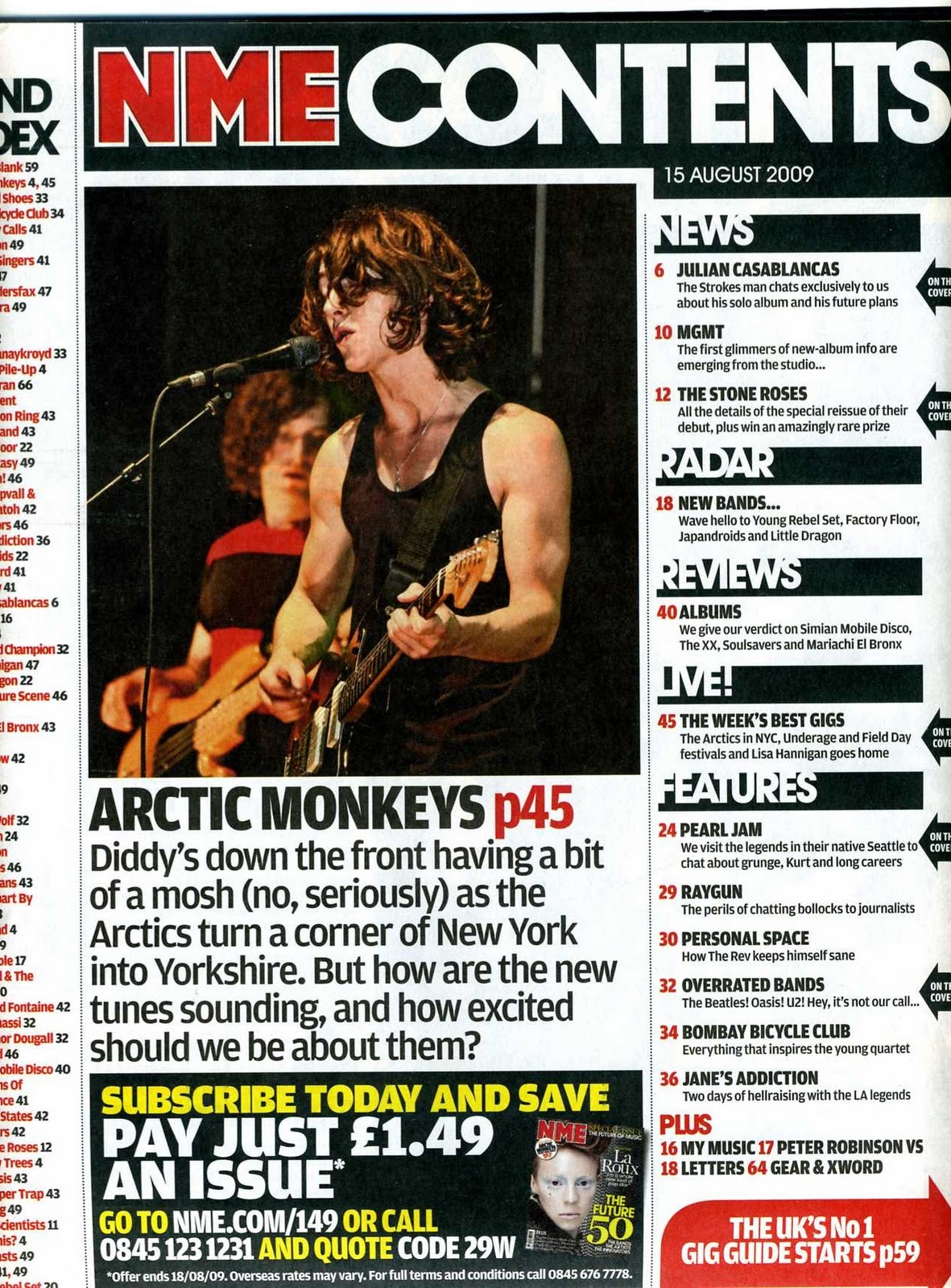
This happens to be the contents page for a music magazine, but before I start I want to clarify that at this point in time my focus is to outline the conventions, rather than do a complete deconstruction. 

  1. Firstly, the logo of the magazine is present again on the contents page as well as the front cover, which reinforces the sense of ownership and control over this particular product. It establishes continuity.
  2. A distinguishable feature is the columned structure. This makes it easier for the audience to read because there are less words per line. In addition, the ascending layout creates flow between the individual sections of information because by moving down the page you feel directed as to which part to read next, thus creating chronology.
  3. Within the contents page the content itself is often divided into specific subgroups. In the example above, we can see the contents has headings such as 'News', 'Reviews' and 'Features' which helps to further categorise what you are reading and make it easier to focus on a specific section.
  4. The date and issue number are also normally present in smaller print in the top corner of the page as an act of formality and consistency in time.
  5. Since there is lots of summarised information distributed across the page, using a plain background helps to simplify it. This way it doesn't overload the page and confuse those reading it. Although it doesn't have to be white, an unexciting shade is preferable to something vibrant and imposing.
  6. The colour in general is an essential feature. There should only be a select few in order to avoid overwhelming the reader.
  7. Almost always, there is an image highlighting the main article inside. This will be large and instantly identifiable through a caption and page number, linking it to the content further inside the magazine. The caption to the central image will generally use more text than the other captions on the page to emphasise importance. Other pictures may be used but they will not be as large.
  8. When referring to the articles themselves, there is normally a page number highlighted in a different colour to the text, as well as a heading and a small caption summarising what the reader can expect to find. 

Overall, contents pages tend to be very structured with an emphasis on the information rather than the creative design. I hope to incorporate this effective simplicity in my own product. 

Thursday, 5 November 2015

Introduction to the Main Task


So, with my preliminary complete, it is time to move onto the main task. Not only do I need to produce a front cover for a music magazine, but also a contents page and a double-page spread of the interior. 
Like I did with the student magazine, the first steps I take will be to examine the generic conventions of a contents page and a double-page spread (I am discluding the front cover because I have already analysed this in my prelim) and then I will start to deconstruct a variety of music magazines. 

Tuesday, 3 November 2015

Contents Draft


The brief stated that we needed to do a draft contents page. In a contents page there needs to be a continuation of the initial colour scheme and fonts from the front cover as well as a more in depth summary of what the magazine includes. 


Firstly the background colour is an extension of the salmon pink I used in the border and masthead of the front cover. When the audience reads they will feel that there is a fluency to the structure and thus it seems more organised. 
Additionally, using 'In this issue you will find' is a way of introducing the audience to generalised topics in the magazine. In many hard copies I examined, the contents page had multiple sections, such as 'features' as well as 'regulars'. This helps to act as a clarification to the audience of  what they are reading. 
The decision to use 'Features' instead of contents was largely due to the connotations that come with the word 'contents'. For example, contents are associated with books and longer pieces of literature which isn't the medium I am representing. Therefore 'features' is a more modernistic take on a contents page and gives the content a more exclusive appeal.
The blue rectangles represent the articles listed on a contents page. As shown in the top one, I included a page number (8), a headline (Keeping Organised) and finally a summary of the article itself. This helps a reader to define which articles are worth reading and allows them to personally decide what sections to explore. Also I made the font mirror that of the cover line relating to this article on the front cover to further enhance the impression of flow. 
The page number in the bottom corner is just a conventional feature that enables the reader to establish where they are in the magazine and helps to make searching through it more structured. 
Finally, the three images arranged down the bottom right hand corner would link to the articles. Since there is only space for three whereas the list of contents consists of more, I would use the images to represent a variety of the articles rather than have them all linked. This would show the diversity of a sixth form and thus correlates to the symbolic theme of personal choices crucial to a student's future. 


Sunday, 1 November 2015

Finishing Photoshop

When I returned and examined my previous work I decided that the illuminated colour scheme with the green and blue font and border was too imposing. I didn't mind the aqua blue but I thought that the green did not distinguish itself from the natural backdrop and was therefore harder to read. With this in mind I experimented with other neutral colours and found that salmon was a suitable replacement. I think that this shade recovers some of the formality that toxic green lost and is more complementing towards the overall picture. It can also be seen that I changed the colour of the selling line from yellow to salmon because I wanted a sense of connectedness that correlated with the word 'Us' in the masthead. It also provides a balance and isn't too overwhelming to view. 


Another change I made was to add the logo of a brand into the cover. This is not permanent but I wanted my exclusive competition to win a Macbook to be associated with a modern company. I chose HMV because it is very up to date with technology, music and films and is a dominant seller in the home video department. With a known brand advertised on the front I think that the magazine is given an increase in prestige because readers will start to associate HMV with the sixth form itself. The other change I made was altering the colour of the border rectangle surrounding the sixth form image. I felt like this enabled it to become interconnected with the other aqua blue rectangles which reduced its isolation at the bottom of the page. 
Below is the revised finish product of my magazine. I prefer it due to its subtlety which carries the implication that it's not trying too hard to appeal to the audience, it simply adheres to a basic but impactful sense of community and achievement.