Saturday, 31 October 2015

Photoshop: Phase 4


When I examined my former work, the first thing I decided was to adapt the font of my third cover line to provide a bolder outlook. As shown above, the words have a thicker density and appear more solid so that they are recognisable from a distance. 


Additionally I wanted to contrast the bold and structured font of the cover lines to show differentiation, and I chose to alter the second cover line (as shown above) to appear as a handwriting format. This was the right sentence to adapt because it is the middle cover line and so divides the other blocky fonts, establishing variation. 


This was the first overall impression of my cover. In my opinion this can be seen as a completed final product, but there was a sense of fragmentation with the gap between the second and third cover line.  I concluded that the empty space needed to be utilised in a more effective way because at the moment the gap is more distinguihsable than the cover lines themselves.
However I felt that including more text on the content would be too overpowering for the front cover, which meant that I needed something relevant but not specifically academia based. I did some further research on magazine covers and found the common trend of competition advertisements. Many magazines offer a competition to win a free Ipad or tickets to an academic festival, so I thought this was a way to evoke engagement with the audience. 


 I chose to advertise a Macbook over an Ipad because an Ipad is too common nowadays and I wanted a formal product to cause interest. The striking pink colour of the advertisement as well as the circular shape allows for distinction between the cover lines and this separately focused competition. The only negative implication this carried was the simplicity of a circle; the shape needed to be chaotic in order to demonstrate luck and the 'out of the blue' chance to win a prize. 


The spiky outline adds a protrusive appearance as if the ad is bursting out of the cover. For me this enhances the appeal because it expresses the rarity of a free Macbook and distinguishes it from the ordered layout of the other cover lines. 

My design is shown above. Before I am settled with it I intend to review the layout and add some finishing touches to finalise the cover.

Thursday, 29 October 2015

Photoshop Design: Phase 3


This was the point where the cover would really start to appear succinct. I selected a selling line 'Connect.Cooperate.Create.' The use of alliteration makes the message clear, blunt and fluent, whilst the meaning of the words acts as a progression from meeting people (connect) to working with them (cooperate) until finally you produce outstanding results together (create). The yellow colour choice was intended to continue to represent the natural world as well as provide a contrast to the green and blue already striking out. 

Also shown in the print screen above is the addition of a secondary image. In my flat plans I thought it would be best to include a couple more images in order to give the cover visual variation, but upon pasting the new image onto the cover I decided that it would appear too unfocused. The image I chose was one that balances the idea of success by stating information about the sixth form, which meant that it gives the audience a representation of part of the interior. Since it  depicts the lobby, anyone reading will find it inviting and captivating. 


The problem I faced was sizing and placing the image. Originally I had wanted to situate it in the bottom right, but when I tested this it was too concealing of the subject in the main image. Therefore I realised that I needed to place it on the left to balance the focus on both sides of the cover, which meant moving the barcode. Although before I stated that I wanted to keep the barcode landscape in order to look orderly, upon reflection it looked too correlating with the secondary image in a flat position and so I rotated it 90 degrees to appear less imposing. 


The cover lines were a tricky process. I wanted to give the main cover line a stand out impression, the predominant importance. Therefore I placed 'EXCLUSIVE' above to convey urgency.  Selecting the content needed to be relevant as well as engaging to a sixth former. For me personally, starting sixth form was a very disorganised period that required a serious increase in attention as well as preparation. For this reason I decided that the main focus of my sixth form magazine was going to be organisation, since the main image also depicts this concept. The idea that 'students reveal the secret' creates anticipation and so I thought it would be a suitable way of creating intrigue amongst my target audience. 
I embodied the cover line in a background box that supports the colour of the border, creating the impression that the cover lines are protruding from the borderline. 

Depending on the overall look, I might alter the font and colour of the second cover line. I chose to include a quotation 'Sport should be compulsory in further education' because it makes the reader think about this opinion and sparks debate. This encourages the audience to read further because it is personally relevant to them and also the cover line is not too informative to provide the whole story. 


It may be hard to visualise here, but the idea behind this quote was to support the secondary image. In order to complement the first two cover lines, I thought I would space the third one out and link it with the image. The rhetorical question 'Is our sixth form best for you?' offers a neutral debate that emphasises to the audience that they have the pupil's best interests at heart. The thought that 'former pupils offer advice' carries the implication that the article is neutral and has been written by pupils with first hand experience in the matter. 

This concludes my work for today, and I intend to have one more session on Photoshop to fully complete my design. 


Tuesday, 27 October 2015

Photoshop: Phase 2


With the basics for my magazine cover sorted, the next stages would start to challenge my creative ability. I wanted to manipulate the image to give Tom's figure more depth and make the background more blurred, which would place visual emphasis on the pupil. Although it may be hard to distinguish, I used a method called 'Gaussian blur' which allows you to set a radius for how thick the blur will be. I did this for the whole image and then used the eraser tool to get rid of the blur over Tom's features, thus leaving him in a definitive position in comparison to the background. 
Additionally in the print screen below I have removed the spots on Tom's face (it was his personal request) but it also gives him a more mature, adolescent appearance. 


A common feature of magazines is the barcode and so I decided to place it in the bottom left corner. It is common for advertisers to situate the barcode at a 90 degree angle to leave more space, but for me I wanted to maintain order and straightforwardness in the structure, so I left this unchanged. 


Before moving onto the cover lines and secondary images, I wanted to get a general idea for the font and colour of my masthead, dateline and price tag. 
I concluded that the price tag should be reasonable but not too cheap. Anything sub £1 could be interpreted  as a flyer or a booklet, but if this was going to be a magazine I thought the price should be around the £2 mark. I settled for a figure of £1.95 since this avoids the bluntness of a rounded digit as well as keeps it at a reasonable rate.
In the dateline I aimed at sustaining simplicity. I wrote it as 'November 2015' since it allocates a month and year, which in my opinion is clarifying enough for a reader. It can be identified that these two features were written in the same aqua blue colour that my bordered edge has, thus keeping correlation across the cover.  
The masthead 'Pupil's Perspective' needed to stand out and so I gave it a toxic green colour as well as a different font to demonstrate its importance. Like I planned in my earlier posts, the 'U' and 'S' form the word 'Us', which I also changed the colour of in order to demonstrate the importance of the word. 
For me this font emits creativity without losing too much formality, giving it an aspect of youthful innovation which is supported by the natural colours. 


Sunday, 25 October 2015

Starting to Design

With the selection process complete, I decided to move ahead with starting to design my cover on Photoshop, since I knew that I would need to take some time experimenting with the variety of tools. Airbrushing and photographic manipulation are not my forte and so I thought it'd be most productive to spend my time carefully going through the production process. Before reading further, it should be noted that a lot of the skills I used on Photoshop were self taught and had been observed from tutorials online.

As shown above, I selected the photo with the most natural approach and symbolism from my second batch of images. 
The first step was to open the photo up in the programme. The print screen below depicts this stage. 


I realised that the first problem I faced was the framing of the photograph. Although it portrays a mid shot there is a significant landscape frame to the image whereas magazines use portrait. My first reaction was to change the width of the image, but then I noticed that it would end up compressing the photo and distorting the person. 
The second, more appropriate way to counter this problem was to crop the image before changing it's size, so that the compressing effect will not be as noticeable. As we can see, I have cropped a large amount of the frame to the left as well as the tree trunk to the right, which draws in focus on the character now that the unnecessary space has been cut. 


Despite its visual similarities to the size of an actual magazine cover, the frame appears too square. With the correct width and height measurements, I was able to adapt the image to give it a more rectangular presentation. This was not instant, it took some time figuring out which measurements provided the wanted look. 
Afterwards I thought that the next logical step was to add a border onto my cover. You do this by altering the radius in 'canvas size' to determine how thick you want the border to be. I believe that a border which is too thick can make a magazine look more like a framed photo and so it needed to be a discreet but sharp edge. 

The tricky decision was the colour. At first I played around the idea of a bright/light green to compliment the emerald shade of the leaves, but then decided that it would give the overall cover too much of a natural theme. I envisioned having a balance of colours, not too many but not too few. I decided that the colour working best with dark green was aqua blue, and decided to settle with this for my border. 


Friday, 23 October 2015

Third Range of Photographs


This is the outcome of the final photographs we took. We experimented with a different setting and directed our focus towards using props. These 6 are the ones that represented the best quality of the shoot. 

1
We wanted to try and capture the idea of studying and motivating a student to do the same. Although I think the concept was understandable, the flash of the camera has given the image too much illumination and therefore I don't think it works well. There is also a negative pathetic fallacy in the weather which creates a depressing tone. 


2
I think the creative thought behind this photo is ideal.  The use of construction represents more than just the student's creative ability, but the ability to build and grow. How he is looking through the tunnel makes it seem as though he has a journey to make, and the use of the coloured sticks in the construction emphasises how the journey is full of vibrant, changing stories. 

3
An improved version of the photo, I prefer Tom's facial expression in this due to his look of perception and intrigue. There is a sense of satisfaction in his smile but also the will in his eyes to do better. For me it perfectly captures independence, a skill crucial to sixth form. A student should be willing to acknowledge the quality of their own work whilst always striving to improve, and I think this photo achieves that. 

4
I toyed with the idea of adding another student in the frame to establish companionship and how 'building' is a task of teamwork. Although I think the blurred effect works, it draws too much attention away from the accomplishment of the student and adds distance to the photo, making it look less like a mid-shot. 

5
There is a strong theme of parallel here, starting with the monitors and then extending towards the students. It emphasises how the equipment and the site is all the same, but it is the students who make their own interpretations and uses of it. The only problem for me is that the background wall of the frame is too bland and ineffective, making this look like an empty classroom.

6
There is a strong idea of support in this photo, both in friendship and with the teacher in the background. Two students using one computer demonstrates teamwork, whilst the maturity of their facial expression implies the level of education they're in. Although effective through representing the growing technology in the modern world, I prefer the use of nature (see my second lot of photos) and so I think I will look at using one of them for my final piece. 

Wednesday, 21 October 2015

Second Range of Photographs


This second batch of photos seemed to be a lot more creative and professional due to our learning from the mistakes we made during the first shots, such as ineffective use of mis en scene. Once again we had taken numerous photographs, but the ones above are the shortlisted selection which reflect our best work. 

1
The setting was taken into account a lot more here, and as you can see there is a balanced combination of school architecture and nature in the backdrop of the photo. I like the way that this presents school as a pure and natural place, which could symbolise growth and expansion of a student's mind. Furthermore the formality of my outfit and expression is far more suitable for a sixth former, showing pride and respect for the rules.

2
This photo of my friend Tom is my current favourite out of all the shots we have. Firstly, the emerald coloured leaves act as an idyllic use of nature that I thought would be a suitable background on which to put the cover lines. Not only this but the glimpse of the school minibus beyond the tree depicts that the leaves are like a curtain that draw back to reveal the sixth form. This establishes a sense of mystery and anticipation since the reader won't be able to work out the clear image beyond. Tom himself is positioned sideways and I like this due to the simplicity that he could be looking at anything in the distance. The slight smile on his expression leaves his true thoughts to the reader's imagination. But there is also a sense of perspective to his pose that connects with the masthead 'Pupil's Perspective'. 

3
This is like the image above but has just been taken from a further distance and has Tom looking directly at the camera instead of side on. As much as I think this photo works because he looks strong-willed and prideful, there is too much centralisation towards the overall image. I liked the second photo more because I had Tom positioned more to one side which left space for cover lines to be placed without the threat of looking too insignificant. For me there are too many gaps in the tree and its branches, which is contradicting my former idea of using the sheet of leaves as a shield that blocks out the scenery behind. 

4
Firstly it should be noted that this was never shot with the intention of using it as a front cover, however I am debating with the idea of using it as a smaller secondary image on the page. I believe that the light blue colour and institutional theme will balance the use of nature in the main photo. It shows the logo and states 'sixth form' as well as provides a brief and concealing depiction of the inside of the buildings, giving any reader their first insight into the content of the magazine. 

Monday, 19 October 2015

First Range of Photographs


From our first photo shoot these are the four images that I think would appear suitable for my magazine cover. We experimented with a range of angles whilst keeping the mid-shot throughout. The setting is our school. 


1
I like number '1' the least due to its mis en scene. The bin and clutter of multiple buildings may appear too overwhelming on the front of a magazine cover, distracting the reader from the cover lines. Despite this I like the angle of my head as well as the combination of natural light and shadow, symbolising that I am looking into brighter directions. 


2
The poignancy of looking upwards is that it represents ambition, the idea that I am striving towards higher goals. I like the concept and symbolism of the angle, but in my opinion my facial expression is too indistinguishable and the background is too artificial. Despite this I feel that on Photoshop I could manipulate the image to look like a plausible cover photo.


3
Much like the second photo, this uses angle to emphasise meaning. The low angle shot can symbolise that I am in a state of success and that by reading the magazine the reader is striving towards the same achievements. I also like the use of nature in the background, but for me the size of the frame makes me look too insignificant amid the mis en scene, and therefore juxtaposes the symbolism that I am the main focus. 


4
Out of them all, this is my preference. I like the concept of friendship that is evoked through our facial expressions, as well as the implication that we are comfortable talking to each other, which would make the audience at ease. Additionally I like the lack of definition and focus in the actual photography since it would make the cover lines easier to read because the image wouldn't be too distracting to the reader.


Saturday, 17 October 2015

Flat Plan 3

This third flat plan features a combination of aspects from the previous designs. Firstly, I decided to follow the idea of keeping statistical features (E.g. the dateline and bar-code) isolated in the top and bottom corners. 
Along with this, I moved the selling line to a central position in order to give it focus away from the cover lines on the left. 
However I have chosen not to run with the idea of placing my cover lines on alternate sides of the cover. Grouping them together gives the information structural significance and makes the details seem more established. 
Separating the cover lines and the secondary images is the 'Extra Information' in the jagged border; I deliberately positioned this inbetween the rectangular blocks of information to show creativity in the variety of shape structures. 
At the moment I have a preference towards this flat plan since it combines a range of features but doesn't distract you from the main image. It also has depth by demonstrating the different layers (the cover lines in the foreground and image in the background).

Thursday, 15 October 2015

Flat Plan 2


Much like my first plan, I have placed my masthead in the same place to give it a heightened position. However I have put the dateline and price tag both above the masthead, since this keeps them away from the main articles of the front cover. 
Another difference is the alternating placement of the cover lines, where each has a different position it gives the reader the impression that the magazine is busy and bursting with information. 
As well as this I gave the primary figure in the image a more central framing, thus giving them attention and authority. I also thought it could give the magazine depth and allow the cover lines to stand out in the foreground.
Including another two images on top of the main photograph allows the reader to connect with the variation of visual appeal. In my opinion photos show the audience visual evidence of what they are reading about and so appear honest. 
Unlike my decision to include some 'extra information' in a circular border in my first plan, I gave this one a more striking shape. The jagged lines and random points are comparable to a comic book speech bubble, often used for dramatic effect. I think that this sharp border would give the information inside urgency and catch the reader's attention. 


Flat Plan 1


My first flat plan is a very conventional sketch. The Masthead is located at the top of the cover with the selling line positioned directly underneath it. In addition to this, the dateline and price tag are found in small print above and below the masthead in order to lower their importance since they only provide statistical information. 
I decided to allocate the left hand side to the cover lines in order to give it a structure and fluency, while also giving the main image complete control of the right side so that there are no distractions towards the photography. So as to not appear bland I used a secondary image to promote the range of content inside, with the belief that the audience will be more engaged if there is a variety of visual evidence to view. 
The bar-code is situated in the bottom corner due to it's lack of relevance. Keeping it isolated means it cannot interfere with the main content of the front cover (although I am not a professional retailer I still feel like it will add authenticity to the magazine if one is included).
Finally, I wanted to add more creativity to the plan which is the reason for 'Additional Cover Line' being presented in a circle. I did this to try and fill the emptiness of the rest of the cover as well as show differentiation between the articles of the other cover lines. 


Wednesday, 14 October 2015

My Masthead


Choosing a suitable title for my magazine cover plays a major part in attracting audience. As I analysed earlier, the masthead should be an instant, eyecatching feature and designed in a unique font. Below is the shortlist I came up with and the reasons I considered each one an appropriate masthead.


Possible Titles
  • Student Hub
  • The Sense
  • Continuance
  • The Extension
  • Pupil's Perspective

  • Student Hub: Firstly, the word 'Student' has connotations of education and academia, also symbolising a less prestigous stage of school life, and so could be applied towards a sixth form or below. Additionally 'Hub' emphasises a collective location and has resemblance to a central base or a fixed point.This establishes the idea of community and shows how the readers of the magazine can be seen as a team.
  • The Sense: I thought this was a short and blunt title that could create mystery. In terms of the semantic meaning, 'sense' refers to something which can be perceived using the body's receptors. The implied meaning in this example would be referring to a student's mental 'senses'. Using the determiner 'The' enables the masthead to appear abrupt and concise, giving it an omittive authority. However on consideration I think this would be too aggressive as a masthead for an educational magazine.
  • Continuance: I liked this masthead due to the simplicity of the word. 'Continuance' insinuates that this magazine would be ongoing and implicates how there would always be more content to explore, metaphorically relating to the hectic lives of students. Not only this, but the theme of continuation provides reassurance towards the reader, leaving the suggestion that the magazine will constantly be there to offer advice or enlightenment.
  • The Extension: Of course, 'extension' refers to the additional school tasks set if you are ahead with the lesson's work. But in this masthead, 'extension' can also refer to how the magazine is an extension of school life, providing the reader with the necessary extra information. Although I think this magazine works well, I think it has implications of 'high flyers' and would put off students who are less academically successful.

Pupil's Perspective

After some review, this was the title I chose to adopt as my masthead. 'Pupil' is a more formal way of addressing sixth formers and so I think it would assert professionalism to the magazine. Not only this, but 'perspective' contributes to the idea that the magazine would be based around the views, issues and suggestions of sixth form pupils. This makes them seem in control of the magazine and so would establish trust between reader and author.
From a technical aspect, the alliteration of the phrase allocates the masthead rhythm and enables us to say pronounce it in a fluent, continuous way. Another reason why I have chosen this is because I feel like I can use it to creative advantage when I design my front cover. I plan on taking the 'U' in 'Pupil's' and the 'S' in 'Perspective' and colouring these two letters in a separate shade to the rest of the title in order to highlight the word 'us' within the masthead. This would contribute to the communal outlook of sixth forms and make the reader seem like they are part of a larger minority.


Monday, 12 October 2015

Sixth Form or College?


Whether to target a sixth form or college magazine is the first decision in the designing process, because it will determine the formality and content of the front cover. I have chosen to produce the magazine cover for a sixth form. This is because I am also currently studying at a sixth form and therefore I will be more comfortable with understanding the mentality of a student in that situation.

Sixth form occurs between high school and University and is an educational place where students undergo their A levels.  This means that my target audience will be teenagers aged from 16 to 18, academically in years 12 and 13. My next step will be to come up with an original masthead relevant to the genre and themes of a sixth form, and then to design several front cover sketches to determine my preferred layout, before I start focusing on the content itself.


Saturday, 10 October 2015

The Next Stages


With my analysis and preparation research complete, it is time for me to start designing my own front cover. Like I posted at the start of my blog, here is a list of goals for the next few weeks and a breakdown of what I need to do:
  1. Choose the audience: The preliminary brief states that we are creating a front cover for a sixth form or college magazine, so I will need to choose between the two before proceeding.
  2. Decide on a suitable Masthead: A major feature of the front cover is the masthead, so I should think both strategically and creatively when coming up with plausible titles.
  3.  Flat Plans/The Initial Layout: Preceding the digital construction on Photoshop, I am going to sketch some flat plans with possible ideas for the layout of my cover so that I can present a range of structured options that I can select.
  4. Take/ Select Photos and justify the choice: The brief states that we need original images, so I need to take a variety of photographs before settling on the main front cover image. When taking them I should consider mis en scene, lighting and the camera angle whilst also bearing in mind that the main image needs to be a mid-shot.
  5. Start designing the front cover: With my masthead and pictures and a general layout selected, the next step will be to start constructing my cover on Photoshop, 

Wednesday, 7 October 2015

Audiences


Audiences in Media

In order for a product or text to be effective, institutions need to closely analyse their audience in order to determine the best way of appealing to them. Advertisers use creative techniques which engage viewers and manipulate their perspective. Below are some of the ways and theories used to classify the audience.


Audience Segmentation


Audience segmentation is the process of dividing audiences into homogenous (similar) sub-categories based on psychological and social factors. This technique allows brands to tailor a product to our needs. These sub-categories define how a group of people share similarities in lifestyle and can therefore share similar needs.
Vance Packard was the author of book 'The Hidden Persuaders' which launched his career form a journalist to social critic. In it Packard analysed how advertisers manipulate expectation and induced the desire to obtain certain products. The book received acclaim for observing the subliminal motivation  and exploring strategies undertaken by organisations.

British Social Grading Scales 


Social GradeSocial StatusOccupation
A upper middle class higher managerial, administrative or professional
B middle class intermediate managerial, administrative or professional
C1 lower middle class supervisory or clerical, junior managerial, administrative or professional
C2 skilled working class skilled manual workers
D working classsemi and unskilled manual workers
Ethose at lowest level of subsistence state pensioners or widows (no other earner), casual or lowest grade workers


The British Social Grading Scales try to segregate society based on their professional state. It was originally established by the National Readership Survey (NRS) to classify readers but has since been utilised for market research in many areas. This particular method enables institutions to isolate a specific class within a society.


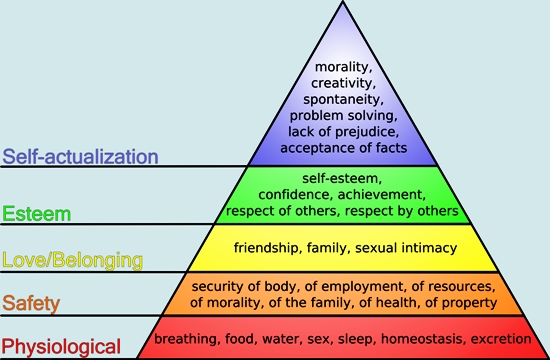
Abraham Maslow's Hierarchy of Needs


This was a theory in psychology proposed in 1943, studying the reason behind motivation. He believed that people possessed motivation unrelated to rewards or unconscious desires. Once motivation has resulted in the achievement of certain needs, only then can a person progress to the next stage.
The media industry will use these stages to interact with an audience and apply products to specific needs on the hierarchy.

Monday, 5 October 2015

Analysing a Front Cover: NO 4


After analysing the critical aspects of a professional front cover, I thought it would be appropriate to look at the finished work of a student undergoing a similar task in order to determine what conventions are successful and what aspects need improving. Above is the work of Alex Allin, and this was his final product. 

As a sixth form magazine, I believe he has understood the content of a magazine to establish his cover lines, using relevant articles such as 'University Applications' and 'UCAS' which specifically apply to students of that age. However his masthead, 'The Sixth', lacks originality and so I don't think this is effective in distinguishing it from other covers. Despite this, the stocky font and lilac colour imply creativity and doesn't distract the reader from the cover lines or main image. One missing convention on the cover is the dateline and selling line, and the lack of these diminish the front cover's credibility and would look unprofessional to a reader. 

The main image itself has contrasting insinuations. On one hand the student appears punctual (through using a watch) while on the other hand his facial expression depicts a look of discomfort, and the way in which he is gripping the railing adds to this suggestion. The bland contrast of his white t-shirt onto the grey brick wall provides a smooth transition between foreground and background, adding depth to the frame. The white circular object behind the subject of the image could have been used for a cover line since leaving it blank creates emptiness. Also there is a noticeable lack of gender mix within the photos, which has connotations that females are underachieving and thus has a sense of bias.  

The range of font styles allows differentiation between topics, establishing a diverse culture within his sixth form. I think that his cover lines are strategically placed so as to not overwhelm the cover but still give it a busy appearance. Unfortunately I think that the placement of the images needed to be spaced out more, rather than cramming them into the bottom right hand corner. 

In summary, the layout and variety of fonts and articles make the front cover a plausible read, but the insufficient use of empty space draws attention away from the cover lines themselves.

Saturday, 3 October 2015

Analysing a Front Cover: NO 3


This magazine cover has a modernistic style. Both the colour and scale of the masthead boast creativity and prove visually striking. The gradual contrast from bright pink to a sky blue is an interesting transition. By using colours with uplifting connotations it could represent the mixed gender, pink and blue could stereotypically represent girls and boys so this may be a marketing ploy to engage with all students.  

In continuation of the vibrant colour, the main cover line 'Have you been snapped?' uses an illuminating yellow, which resembles that of a glowing billboard outside a nightclub. This may also be a deliberate reference towards the lifestyle of students, where clubs and other activities are a common hobby. The term 'snapped' in the main cover line is a pun reflecting the camera in the picture and the possible theme of being spotted. Including 'Gloucestershire College' in the lens of the camera expresses the idea that they are hunting down talented individuals, who could possibly specialise in creative arts.


Unlike the masthead and cover line, the main image uses the dullest colours on the cover which creates a distinguishable contrast between word and photo. The close up shot adopts a level of brightness that links with a retro theme, and also has definition that exceeds that of colour photography. The angle of the shot is clever, so that the focus of the photo is not the man holding the camera, but the camera itself. The way in which the photographer is directing the lens towards the reader uses subtle direct address to communicate. It engages them by making them feel like they are in the spotlight and the centre of attention.  To add to the direct address, the main cover line includes the pronoun 'you' in order to personalise the message and cause you to subconsciously consider with the question.
     
In comparison to the other magazines, this one adopts a similar style to the Magdalene Matters newsletter, which hardly used any text on the cover and drew focus towards the main image. The main result of this strategy is that it creates intrigue, readers will turn the page in order to examine the content before they decide whether to purchase it.