Audiences in Media
In order for a product or text to be effective, institutions need to closely analyse their audience in order to determine the best way of appealing to them. Advertisers use creative techniques which engage viewers and manipulate their perspective. Below are some of the ways and theories used to classify the audience.
Audience Segmentation
Audience segmentation is the process of dividing audiences into homogenous (similar) sub-categories based on psychological and social factors. This technique allows brands to tailor a product to our needs. These sub-categories define how a group of people share similarities in lifestyle and can therefore share similar needs.
Vance Packard was the author of book 'The Hidden Persuaders' which launched his career form a journalist to social critic. In it Packard analysed how advertisers manipulate expectation and induced the desire to obtain certain products. The book received acclaim for observing the subliminal motivation and exploring strategies undertaken by organisations.
British Social Grading Scales
| Social Grade | Social Status | Occupation |
| A | upper middle class | higher managerial, administrative or professional |
| B | middle class | intermediate managerial, administrative or professional |
| C1 | lower middle class | supervisory or clerical, junior managerial, administrative or professional |
| C2 | skilled working class | skilled manual workers |
| D | working class | semi and unskilled manual workers |
| E | those at lowest level of subsistence | state pensioners or widows (no other earner), casual or lowest grade workers |
The British Social Grading Scales try to segregate society based on their professional state. It was originally established by the National Readership Survey (NRS) to classify readers but has since been utilised for market research in many areas. This particular method enables institutions to isolate a specific class within a society.
Abraham Maslow's Hierarchy of Needs
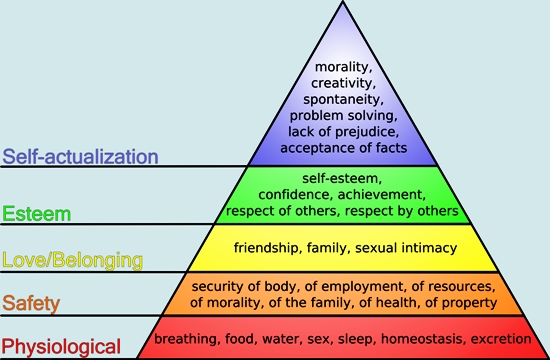
This was a theory in psychology proposed in 1943, studying the reason behind motivation. He believed that people possessed motivation unrelated to rewards or unconscious desires. Once motivation has resulted in the achievement of certain needs, only then can a person progress to the next stage.
The media industry will use these stages to interact with an audience and apply products to specific needs on the hierarchy.
No comments:
Post a Comment